
ProActive Physical Therapy & Sports Rehabilitation — Valhalla, NY
Blood Flow Restriction (BFR) Therapy is one of the most exciting and research-supported advancements in modern physical rehabilitation. Whether you’re recovering from surgery, suffering from chronic weakness, trying to restore muscle after injury, or looking to enhance performance, BFR offers a unique and powerful way to trigger strength and hypertrophy using light load exercise.
For many patients, lifting heavy weights simply isn’t possible. Post-surgical precautions, pain, limited mobility, or fear of reinjury often prevent people from training at intensities required for strength and muscle regrowth. BFR solves this problem by creating a physiological environment that mimics high-intensity training—all while using safe, low loads that protect healing tissues.
At ProActive Physical Therapy & Sports Rehabilitation, our certified clinicians use evidence-based BFR techniques to help patients recover faster, build strength safely, and achieve functional goals that may otherwise take months longer to reach.
This article serves as your complete, long-form guide to understanding BFR: what it is, how it works, who it benefits, and what to expect during treatment.
1. What Is Blood Flow Restriction (BFR) Therapy?
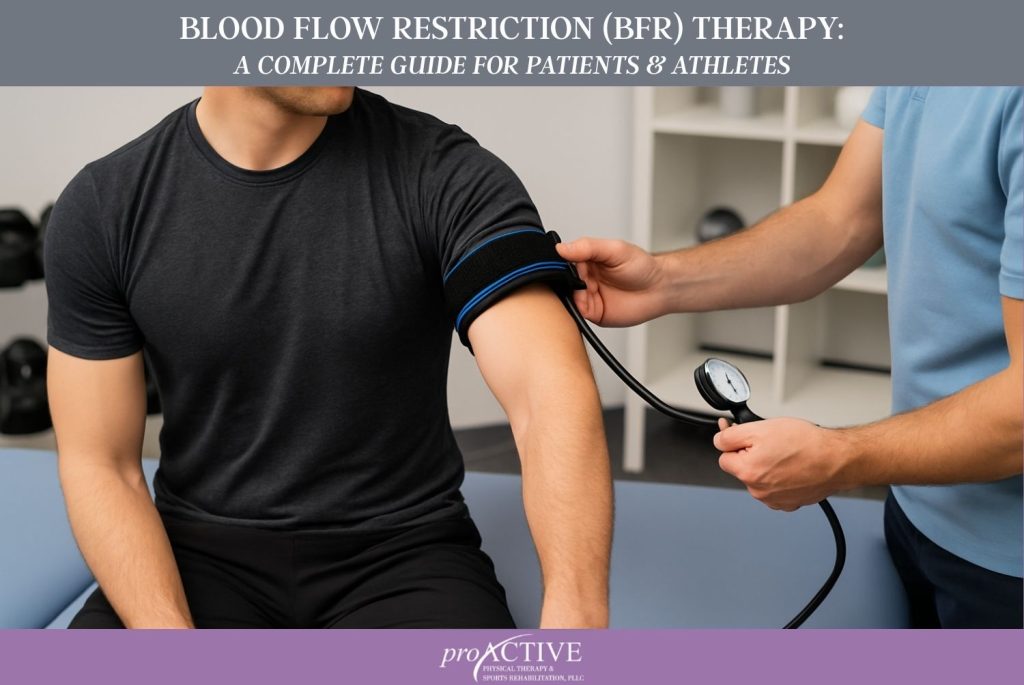
Blood Flow Restriction Therapy involves placing a specialized cuff or band around the upper arm or upper leg to partially limit venous blood flow out of the limb while allowing arterial blood to continue entering. During low-load exercise, this creates a powerful metabolic environment that stimulates muscle growth and strength gains similar to heavy lifting.
Key Concept:
BFR tricks the body into thinking it’s working harder than it is.
Why This Matters:
- Patients can train hard without heavy loads.
- Healing tissues avoid excessive strain.
- Strength gains occur much sooner during rehabilitation.
The technique was first developed in Japan in the 1960s under the name KAATSU training, but over the past 20 years, extensive research has led to its adoption in orthopedic rehab, sports performance, military physical training, and general fitness.
2. The Science Behind BFR: How It Works
BFR is grounded in well-understood physiological mechanisms. Here’s what happens inside the body during treatment:
2.1 Metabolic Stress and Muscle Fiber Recruitment
When venous blood flow is restricted, metabolic waste products accumulate in the muscle. This increases:
- Muscle fiber activation, including fast-twitch fibers
- Growth hormone production
- Cellular swelling, which stimulates growth
- Fatigue signaling, which increases muscle adaptation
This environment mimics the metabolic stress of lifting at 70–80% of one-rep max, even when patients are lifting only 20–30%.
2.2 Increased Growth Hormone and IGF-1 Release
Research shows that BFR triggers a significant hormonal response, including:
- Growth hormone releases up to 290% higher than normal low-load exercise
- IGF-1, a key driver of muscle repair
- Decrease in myostatin, which normally inhibits muscle growth
This hormonal shift accelerates recovery after injury or surgery.
2.3 Muscle Protein Synthesis Activation
BFR influences:
- mTOR pathways
- Satellite cell activation
- Enhanced collagen formation
These are essential for rebuilding muscle after atrophy, particularly following immobilization or surgery.
3. Who Can Benefit From BFR Therapy?
BFR is extremely versatile and useful for nearly all patient populations. At ProActive Physical Therapy, we commonly recommend BFR for:
3.1 Post-Surgical Patients
Especially beneficial after:
- ACL reconstruction
- Meniscus repair
- Rotator cuff surgery
- Total knee replacement
- Fracture fixation
BFR helps patients rebuild muscle before they can tolerate heavy resistance exercise.
3.2 Athletes Recovering From Injury
Athletes naturally want to return to play quickly—but safely. BFR allows increased training stimulus without violating tissue-loading precautions.
Great for:
- Tendon injuries
- Muscle strains
- Post-operative restrictions
- Off-season strengthening
3.3 Individuals With Chronic Weakness or Deconditioning
People suffering from:
- Osteoarthritis
- Age-related muscle loss
- Chronic pain
- Mobility limitations
- Neurological conditions
Can build strength without aggravating symptoms.
3.4 Patients With Weight-Bearing Restrictions
For someone unable to load a limb due to:
- Pain
- Fracture
- Surgical precautions
BFR allows meaningful strength training with extremely light resistance.
4. Conditions Commonly Treated With BFR Therapy
At ProActive Physical Therapy, BFR is used to treat:
- ACL and knee ligament injuries
- Post-op rotator cuff and shoulder repairs
- Achilles tendon injuries
- Meniscus injuries
- Quadriceps and hamstring weakness
- Tendonitis and chronic tendinopathies
- General muscle atrophy
- Pre-surgical strengthening (“prehab”)
The research supporting BFR’s effectiveness in these areas is robust and growing.
5. What to Expect During a BFR Session
Patients are often curious or nervous about what BFR “feels like.” Here’s what to expect.
5.1 Placement of the Cuff
A wide, comfortable pneumatic cuff is placed on your upper arm or upper thigh depending on which area is being trained. The cuff is inflated to a personalized pressure determined through safe protocols.
5.2 The Sensation
You may feel:
- A snug, compressive pressure
- Mild fatigue much earlier than expected
- A warm or “burning” sensation in the muscle
This is normal and indicates proper metabolic stress.
5.3 The Exercises
Exercises are low-load and may include:
- Straight leg raises
- Mini squats
- Knee extensions
- Bicep curls
- Walking or cycling
- Hip strengthening work
Even simple movements become extremely effective under BFR.
5.4 Duration of the Session
Most BFR sets follow the 30-15-15-15 protocol:
- 30 reps
- 15 reps
- 15 reps
- 15 reps
With short rests between sets.
The entire BFR portion typically lasts 6–10 minutes.
6. Safety of BFR: What Patients Should Know
When performed by a trained clinician, BFR is very safe. Modern cuffs allow precise pressure control, reducing the risk of complications.
Patients often ask about safety concerns related to:
- Blood clots
- Blood pressure changes
- Tissue damage
However, research involving thousands of subjects has shown extremely low rates of complication when BFR is applied professionally.
6.1 Patients Who Should Not Use BFR
Contraindications may include:
- Active blood clots
- Severe hypertension
- Certain vascular conditions
- Sickle cell disease
- Active infection in the limb
Your therapist will screen you thoroughly.
7. The Advantages of BFR Over Traditional Strengthening
7.1 Faster Muscle Growth
Studies show BFR can produce hypertrophy equal to heavy lifting.
7.2 Less Joint Stress
Perfect for arthritis, post-op protocols, or pain-sensitive patients.
7.3 Improved Functional Outcomes
Patients walk better, climb stairs better, and regain independence sooner.
7.4 Psychological Motivation
Patients feel they are “training hard” without needing heavy loads.
8. Realistic Expectations: How Long Until Results?
Most patients see noticeable improvements within:
- 2–3 weeks of consistent use
- Increased muscle tone
- Better strength
- Decreased pain
For post-surgical patients, BFR often prevents early muscle wasting, which is critical for long-term outcomes.
9. Case Example (Fictional but Representative)
John, 32, ACL reconstruction patient.
He began BFR two weeks after surgery.
Weeks 1–3:
- Improved quad activation
- Reduced pain
- Better gait mechanics
Weeks 3–6:
- Increased quad size compared to typical post-op patients
- Greater confidence
- Returned to functional drills sooner
Week 12:
- Jogging progression began earlier than expected
10. Comprehensive BFR FAQ / Q&A Section
Q: Does BFR hurt?
A: You may feel tightness and muscle burn, but it should not be painful.
Q: Is BFR safe for older adults?
A: Yes. Research supports its use even in elderly populations.
Q: How often will I use BFR in therapy?
A: Typically 2–3 times per week depending on your diagnosis.
Q: Is BFR used throughout the entire rehab process?
A: Often used in early to mid rehab, fading out as patients tolerate heavier loads.
Q: Can BFR replace regular exercise?
A: No — it enhances, accelerates, and complements traditional strengthening.
Q: Does insurance cover BFR therapy?
A: BFR is included as part of your physical therapy treatment when appropriate.
Q: Is BFR good for athletes in-season?
A: Yes — allows training intensity without fatigue from heavy lifting.
Q: How is pressure determined?
A: We use limb occlusion pressure testing to ensure individualized, safe dosing.
…and many more available upon request.
11. Why Choose ProActive Physical Therapy for BFR?
- Clinicians trained in evidence-based BFR protocols
- Safe, medical-grade equipment
- Integration with full rehab plans
- Personalized strength progression
- Experienced staff treating post-op and sports injuries
12. Conclusion: BFR Is a Game-Changer in Physical Rehabilitation
Blood Flow Restriction Therapy is one of the most powerful tools for accelerating strength, rebuilding muscle, and speeding recovery — all without stressing healing tissues. Whether you’re recovering from surgery, managing chronic pain, or trying to return to sport faster, BFR provides clinically proven benefits.
At ProActive Physical Therapy & Sports Rehabilitation, our team is committed to using the most advanced and effective rehabilitation techniques to deliver superior outcomes.
📞 Contact Us to Schedule a BFR Consultation
ProActive Physical Therapy & Sports Rehabilitation
📍 465 Columbus Ave, Valhalla, NY 10595
📞 Call for appointments: (914) 741-2850