
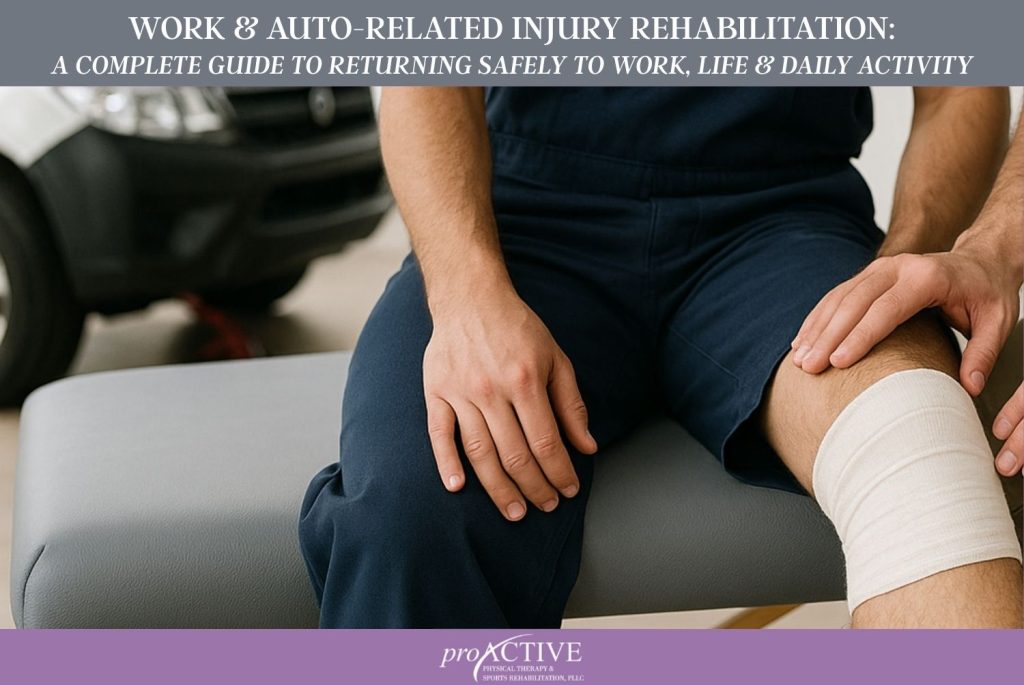
ProActive Physical Therapy & Sports Rehabilitation — Valhalla, NY
Workplace accidents and automobile collisions can disrupt every part of a person’s life — physically, mentally, and emotionally. Beyond initial medical treatment, many individuals are left with pain, stiffness, weakness, or difficulty returning to normal activities. Without proper rehabilitation, these issues can linger, worsen over time, and affect work performance, independence, and quality of life.
Work & Auto-Related Injury Rehabilitation is a specialized area of physical therapy focused on helping individuals recover safely and completely after workplace accidents or motor vehicle collisions. Early intervention is crucial, as injuries often become more complex without timely, targeted treatment.
At ProActive Physical Therapy & Sports Rehabilitation, we provide individualized, evidence-based rehabilitation for patients recovering from work injuries, auto accidents, or repetitive strain. Our goal is to help patients restore mobility, reduce pain, regain confidence, and return to work or daily life safely and efficiently.
This comprehensive guide explains the nature of work and auto injuries, common conditions treated, how rehabilitation helps, and what patients can expect from their journey to recovery.
1. Understanding Work & Auto Injuries
Work-related injuries and auto collisions can vary from mild discomfort to severe trauma. Even low-impact incidents can cause significant musculoskeletal problems.
These injuries commonly involve:
- Joints
- Muscles
- Tendons
- Ligaments
- Nerves
- Soft tissue
- The spine (neck, mid-back, low back)
Immediate symptoms may be mild, but delayed onset pain — especially after auto collisions — is very common.
2. Common Work-Related Injuries
Work-related injuries occur in all industries, from construction and manual labor to office jobs.
2.1 Overexertion & Repetitive Strain Injuries
These injuries develop from repeated movements or poor ergonomics.
Examples:
- Tendonitis
- Carpal tunnel syndrome
- Chronic back or neck pain
- Rotator cuff strain
2.2 Lifting & Carrying Injuries
Common in warehouse, nursing, construction, and maintenance roles.
Associated issues:
- Low back strain
- Herniated discs
- Sciatica
- Muscle tears
2.3 Slip, Trip & Fall Injuries
Can cause:
- Fractures
- Sprained ankles
- Knee injuries
- Shoulder dislocations
2.4 Impact or Collision Injuries
Can occur from machinery, falling objects, or heavy equipment.
2.5 Posture & Ergonomic-Related Pain
Office workers often experience:
- Neck pain
- Upper back tension
- Shoulder pain
- Wrist and hand strain
Workplace design dramatically affects body mechanics.
3. Common Auto-Related Injuries
Automobile accidents, even at low speeds, place large mechanical forces on the body.
3.1 Whiplash
One of the most common auto-related injuries.
Symptoms include:
- Neck pain
- Headaches
- Shoulder tension
- Dizziness
- Limited neck motion
Whiplash often affects muscles, ligaments, discs, and nerves.
3.2 Back Injuries
The lumbar and thoracic spine frequently suffer strain or disc-related injuries in collisions.
3.3 Soft Tissue Injuries
Bruises, strains, sprains, and muscular tightness may worsen without treatment.
3.4 Joint Injuries
Knees, shoulders, and wrists may be injured depending on impact and position during the collision.
3.5 Concussion or Head Injury
Even without hitting the head, rapid acceleration can cause a concussion.
3.6 Nerve Pain
Auto accidents can lead to nerve irritation or compression, causing:
- Tingling
- Numbness
- Radiating pain
4. Why Early Rehabilitation Is Essential
Many patients delay therapy after a work or auto injury, hoping symptoms will resolve. Unfortunately, untreated injuries often worsen over time.
Early therapy helps prevent:
- Chronic pain
- Muscle weakness
- Scar tissue formation
- Loss of mobility
- Movement dysfunction
- Long-term disability
Prompt rehabilitation leads to better outcomes, faster recovery, and lower risk of reinjury.
5. Comprehensive Work & Auto Injury Rehabilitation at ProActive PT
Our rehabilitation programs are tailored to each patient’s injury, goals, and job demands. No two injuries are the same — therefore, no two treatment programs should be identical.
5.1 Initial Evaluation
We begin with an in-depth assessment that includes:
- Postural evaluation
- Joint mobility testing
- Strength testing
- Movement pattern analysis
- Neurological screening
- Pain assessment
- Review of workplace or accident-related factors
We gather information to create a customized treatment plan.
5.2 Pain Management
Before strengthening, we must first address pain and inflammation.
Pain management strategies may include:
- Manual therapy
- Joint mobilization
- Soft tissue massage
- Ice/heat
- Shockwave therapy (when appropriate)
- Gentle movement exercises
Pain reduction allows the patient to progress safely.
5.3 Restoring Mobility
Work or auto injuries often lead to stiffness or limited range of motion. Rehabilitation focuses on restoring normal movement through:
- Stretching
- Mobility drills
- Manual therapy
- Joint mobilization
Mobility lays the foundation for functional strength.
5.4 Strengthening & Conditioning
Rebuilding strength protects injured tissues and prevents reinjury.
We focus on:
- Functional strength
- Core stability
- Upper and lower body mechanics
- Muscle rebalancing
Strengthening helps patients return to physically demanding tasks without pain.
5.5 Neuromuscular Re-Education
Injury disrupts coordination and movement patterns. Retraining these patterns is essential for:
- Lifting
- Reaching
- Bending
- Balance
- Walking
- Workplace tasks
This training improves efficiency and reduces risk of future injury.
5.6 Functional Training & Job Simulation
Returning to work safely requires preparing the body for the demands of the job.
Functional training may include:
- Lifting boxes
- Carrying loads
- Pushing or pulling motions
- Climbing stairs or ladders
- Repetitive tasks
- Prolonged sitting or standing
Simulating work tasks ensures patients are confident and capable.
5.7 Posture & Ergonomic Training
For office workers and manual laborers alike, safe movement matters.
We teach:
- Correct lifting mechanics
- Proper workstation setup
- Body positioning
- Strategies to reduce fatigue
Good ergonomics protect the body long-term.
5.8 Education on Injury Prevention
Knowledge empowers patients to stay pain-free.
We provide guidance on:
- Activity modification
- Proper warm-up routines
- Stretching
- Safe work habits
- Body mechanics
Patients leave therapy with lifelong tools.
6. Return-to-Work Programming
A successful return to work requires:
- Pain-free movement
- Adequate strength
- Endurance
- Confidence
- Ability to safely perform job tasks
We collaborate with:
- Employers
- Case managers
- Physicians
- Insurance representatives
Our goal is always the same: a safe, sustainable return to work.
7. Auto Accident Rehabilitation: Special Considerations
Auto injuries often involve multiple systems — muscular, skeletal, and neurological.
We address:
- Whiplash
- Neck and back strain
- Concussion symptoms
- Jaw dysfunction
- Nerve pain
- Soft tissue injuries
Recovery may involve coordinated care between physical therapy, medical treatment, and imaging if needed.
8. Case Study (Fictional but Representative)
Case: John, 46 — Auto Collision Resulting in Neck & Low Back Pain
Before:
- Severe stiffness
- Difficulty sitting at work
- Pain when turning head
- Poor sleep
Weeks 1–3:
- Manual therapy for neck mobility
- Gentle strengthening
- Pain management techniques
Weeks 4–8:
- Progressive strengthening
- Posture correction
- Neuromuscular re-education
- Return-to-work simulation
Week 9+:
- Significant improvement
- Pain-free driving
- Returned to full work duties
John regained mobility, confidence, and independence.
9. Frequently Asked Questions (Extended FAQ)
Q: Do I need a referral for work or auto injury rehab?
A: Often no — but it depends on insurance. We can help you verify.
Q: Will therapy help even if the accident was months ago?
A: Yes — chronic issues respond very well to targeted rehabilitation.
Q: Can I work while doing rehab?
A: Usually yes — therapy can be scheduled around your work demands.
Q: What if my pain gets worse?
A: Initial soreness is normal, but we closely adjust the program to your comfort.
Q: Can therapy help with whiplash?
A: Absolutely — early intervention speeds recovery and reduces chronic symptoms.
Q: Does insurance cover auto accident therapy?
A: Most auto policies include coverage. We can assist with documentation.
Q: How long will rehab take?
A: It depends on severity, but many patients improve within weeks.
Q: Can therapy prevent reinjury?
A: Yes — we provide long-term strategies for safe movement and injury avoidance.
10. Why Choose ProActive Physical Therapy for Work & Auto Injury Rehabilitation?
ProActive PT offers:
- Experienced clinicians specializing in work & auto injuries
- Customized rehabilitation plans
- Advanced manual therapy & corrective movement training
- Functional and job-specific retraining
- Evidence-based return-to-work protocols
- Supportive, patient-centered care
- Coordination with employers, attorneys, and insurance when needed
We prioritize your recovery, safety, comfort, and long-term well-being.
11. Conclusion: Recover Safely & Return to Life with Confidence
Workplace accidents and auto injuries can be disruptive and overwhelming, but they do not have to define your future. With the right rehabilitation plan, you can rebuild your strength, restore mobility, reduce pain, and return to daily life with confidence.
At ProActive Physical Therapy & Sports Rehabilitation, we are committed to guiding you through every step of the healing process — from initial pain relief to full functional recovery and prevention of future injury.
📞 Schedule Your Work or Auto Injury Evaluation Today
ProActive Physical Therapy & Sports Rehabilitation
📍 465 Columbus Ave, Valhalla, NY 10595
📞 Call for appointments: (914) 741-2850